.png)
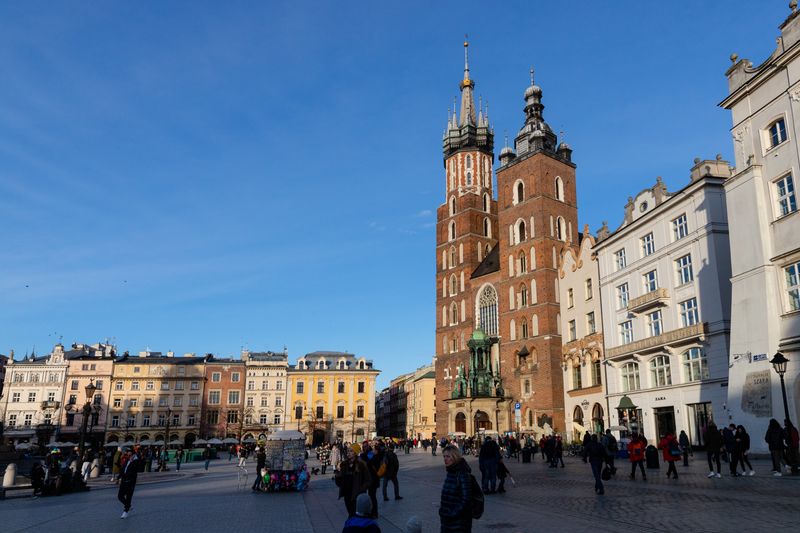
Krakow is Poland's most beautiful city and one of the most remarkable historical cities in Central Europe — a place of extraordinary layered history where a perfectly preserved medieval center, a rich Jewish heritage, the memory of royal Polish kings, and the weight of World War II's darkest chapter coexist within walking distance of each other. Unlike Warsaw, which was almost entirely destroyed and rebuilt, Krakow survived the war with its medieval architecture largely intact, making it a genuinely rare example of a European city that still looks and feels as it did six centuries ago at its core. The Main Market Square (Rynek Główny), the largest medieval square in Europe, anchors a city of Gothic churches, Renaissance courtyards, Baroque palaces, and one of the continent's most intact Jewish quarters. For last-minute travelers from North America, Krakow requires a European connection but rewards the journey with an authenticity, historical depth, and value for money that few European capitals can match.
The Old Town and Wawel Castle
Krakow's Old Town (Stare Miasto), a UNESCO World Heritage Site, is centered on Rynek Główny — a 200-metre-square medieval market square that is unquestionably the finest in Central Europe and ranks among the great public spaces of the world. The Cloth Hall (Sukiennice), a Renaissance arcaded trading hall occupying the center of the square, was the hub of medieval Central European trade and today houses market stalls, a gallery, and restaurant terraces that make the square a living cultural space rather than a museum. At the square's corner, the twin-towered St. Mary's Basilica is the city's most beloved building — its interior, a spectacular fusion of Gothic architecture and 19th-century Polish Historicist decoration, culminates in a 15-metre Gothic altarpiece carved by Veit Stoss between 1477 and 1489 and considered one of the masterpieces of European Gothic woodcarving. Wawel Castle — the former residence of Polish kings on a limestone bluff overlooking the Vistula River — completes the Old Town with a Renaissance-Gothic complex of extraordinary historical significance.
Kazimierz and Jewish Heritage
Kazimierz, the former Jewish quarter of Krakow immediately south of the Old Town, is one of the most important sites of Jewish heritage in Europe and one of the city's most vibrant and atmospheric neighborhoods. Established as a separate town in the 14th century and home to one of the largest Jewish communities in Poland before the Second World War, Kazimierz still preserves seven historic synagogues — including the Old Synagogue (now a museum) dating from the 15th century and the beautiful Tempel Synagogue from 1862. The neighborhood was the setting for much of Steven Spielberg's Schindler's List, and Oskar Schindler's actual enamel factory — now a superb museum of the German occupation — lies just across the Vistula in the former factory district of Podgórze. Today, Kazimierz has been transformed into Krakow's most interesting neighborhood for cafés, independent restaurants, bookshops, and galleries, with an energy that honors its history while building a new chapter.
Auschwitz-Birkenau: A Necessary Journey
Auschwitz-Birkenau concentration and extermination camp, located 70km west of Krakow, is the most visited memorial site in the world and a destination of profound moral significance for any traveler capable of making the journey. The twin camps — Auschwitz I (the original camp) and Auschwitz II-Birkenau (the extermination complex) — receive over 2 million visitors per year and have been a UNESCO World Heritage Site since 1979. The Auschwitz I site, with its preserved barracks, gas chambers, and the infamous "Arbeit Macht Frei" gate, documents the systematic apparatus of the Holocaust with clarity and restraint. Birkenau, by contrast, confronts visitors with the sheer scale of the genocide through its vast, largely unrestored landscape of ruins, watch towers, and the symbolic remains of the crematoria. Most visitors book a guided tour from Krakow; advance reservation is essential, particularly in the summer months.
Food, Vodka, and Krakow's Emerging Restaurant Scene
Polish cuisine is one of the great undiscovered culinary traditions of Europe, and Krakow is the ideal city in which to explore it. The pierogi — small dumplings filled with meat, cheese and potato, mushroom, or seasonal ingredients — are available everywhere from market stalls (at unbelievably low prices) to upscale restaurants. Bigos (hunter's stew), żurek (fermented rye soup with sausage and egg), roast duck with buckwheat and apple, and the excellent Polish charcuterie tradition are all readily available. Vodka — distilled in Poland for over five centuries — is available in regional varieties from potato, rye, and wheat bases, and Krakow's growing craft cocktail bar scene uses Polish spirits as a foundation for genuinely excellent drinks. The food and restaurant scene has improved dramatically in recent years, with young Polish chefs bringing a new sophistication to traditional ingredients while keeping prices far below those of comparable establishments in Western European capitals.
Popular Routes to Krakow
Airlines Flying to Krakow
Best Time to Book Flights to Krakow
Best Months
April – June, September – October
Peak Season
July – August, December
Budget Season
January – February
Travel Tips for Krakow
Nearest Airport
John Paul II International Airport Kraków-Balice (KRK)
Transportation
Trams cover the city center and inner suburbs efficiently. The Old Town itself is compact and best explored entirely on foot. Bikes and e-scooters available throughout.
Weather
Continental — warm summers (65–78°F), cold snowy winters (20–35°F). Spring and autumn are crisp and colorful. December brings a spectacular Christmas market.
Frequently Asked Questions — Flights to Krakow
How do I fly from the USA to Krakow?
No nonstop flights operate from the U.S. to Krakow. Common connections are via London, Frankfurt, Amsterdam, Vienna, or Warsaw. LOT Polish Airlines connects Warsaw to many U.S. cities. Total journey time from New York is approximately 12–14 hours.
Do Americans need a visa for Poland?
No. Poland is part of the Schengen Area. U.S. citizens can visit for up to 90 days without a visa. A passport valid for at least 6 months is required.
How do I visit Auschwitz from Krakow?
The most common option is a guided tour from Krakow (booked in advance), including transport. Alternatively, buses depart regularly from Krakow's main bus station. Entry to the site is free; guided tours have a fee. Book well in advance, especially in summer.
Is Krakow cheap to visit?
Very. Krakow is one of the most affordable cities in the EU. Accommodation, restaurants, beer, and transport all cost a fraction of equivalent options in Western European capitals. An excellent dinner with drinks for two can be had for €25–40.
How do I get from Krakow Airport to the city center?
Bus 208 and 252 connect the airport to the city center in about 40 minutes for around 6 PLN (€1.40). Taxis and Uber take 20–25 minutes and cost approximately 50–80 PLN (€12–19).
What is the best area to stay in Krakow?
The Old Town (within or just outside the Planty ring gardens) is ideal for first-time visitors. Kazimierz is the best choice for travelers who want a more bohemian, neighborhood-oriented experience.
Is Krakow safe for tourists?
Krakow is one of the safest cities in Central Europe and one of the most welcoming to international visitors. Petty theft in crowded tourist areas is the most common concern, as in any major European city.
What are the best things to eat in Krakow?
Pierogi (dumplings), zapiekanka (open-faced baguette pizza from the Kazimierz market), bigos, żurek, oscypek (smoked sheep's cheese from the Tatra mountains), and obwarzanek krakowski (ring-shaped bread sold from market carts).
