.png)
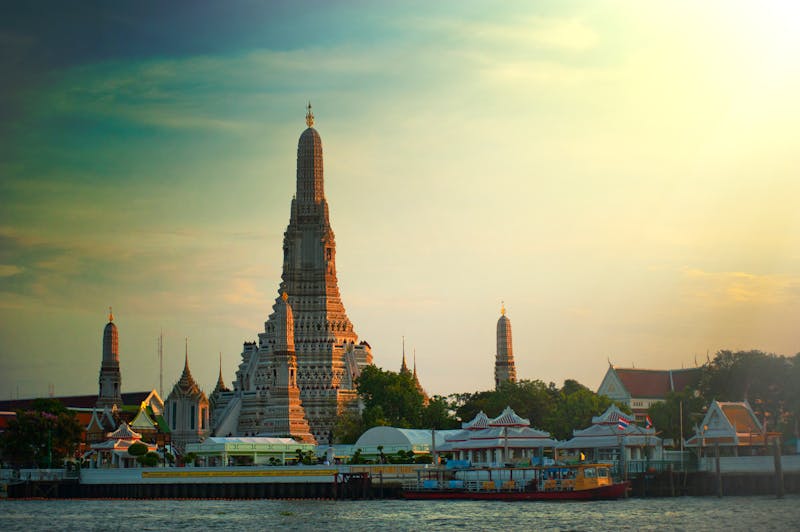
Bangkok is the most overwhelming, most delicious, most stimulating, and most contradictory city in Southeast Asia — and arguably one of the most remarkable cities on earth. The Thai capital layers ancient Buddhist temple culture, royal ceremony, and centuries of Southeast Asian trade history beneath an ultramodern skyline of glass towers, luxury malls, and rooftop bars. Its street food scene is the most celebrated in the world. Its night markets are legendary. Its river and canal network provides a water-based dimension to urban life that is unique. For travelers seeking maximum intensity, Bangkok delivers at every hour of the day and night with a generosity of spirit that is quintessentially Thai.
Temples and Royal Heritage
Bangkok's temples are among the most spectacular in the Buddhist world. Wat Phra Kaew (the Temple of the Emerald Buddha), set within the grounds of the Grand Palace compound, is Thailand's most sacred site — the Emerald Buddha, carved from a single piece of green jade, is housed in an elaborate bot (ordination hall) of extraordinary decorative richness. Wat Arun — the Temple of Dawn — rises 88 metres above the Chao Phraya River in a form encrusted with millions of fragments of Chinese porcelain, producing a shimmering surface that transforms spectacularly in early morning and evening light. Wat Pho, the oldest and largest temple complex in Bangkok, houses the famous 46-metre Reclining Buddha and is also the official home of traditional Thai massage. Together, these three temples within walking or boat-ride distance of each other form the most magnificent religious art complex in Southeast Asia.
Street Food and Markets
Bangkok's street food culture is acknowledged by chefs and food writers worldwide as the finest and most comprehensive on earth. Every alley, canal-side lane, and market corridor offers pad thai, som tum (green papaya salad), tom yum soup, mango sticky rice, and dozens of regional specialties prepared by vendors whose expertise has been refined over decades. Yaowarat Road in Bangkok's Chinatown transforms each evening into one of the most spectacular street food corridors anywhere — seafood grills, roast duck, dim sum, and boat noodles alongside Thai-Chinese fusion that is unique to this district. Chatuchak Weekend Market — with over 15,000 stalls across 35 acres — is the world's largest weekend market and a cultural institution unto itself.
The Chao Phraya and Canals
The Chao Phraya River and Bangkok's historic klong (canal) network provide the city with a watery alternative to its congested streets. The Chao Phraya Express Boat connects major riverside landmarks cheaply and scenically — passing the Grand Palace, Wat Arun, the flower market at Pak Khlong Talat, and the colonial-era Customs House in a single journey. Canal boat tours through the surviving khlongs of Thonburi on the west bank reveal a Bangkok that the skyscrapers and malls have not yet reached — traditional wooden houses on stilts, Buddhist temples embedded in dense tropical vegetation, and local life conducted at the water's edge as it has been for centuries. The Iconsiam waterfront development on the Thonburi bank represents the newest chapter in riverside luxury.
Luxury, Nightlife, and the Modern City
Bangkok's luxury quotient is extraordinary by any global standard. The Mandarin Oriental Bangkok — open since 1876 and consistently ranked among the world's great hotels — anchors a riverside luxury corridor that now extends to numerous international brands. The city's rooftop bar scene — Vertigo and Moon Bar at the Banyan Tree, Sky Bar at Lebua (famous from the film Hangover II), and Octave at the Marriott Marquis — delivers cocktails at altitude with incomparable nocturnal panoramas. The Asiatique riverfront night bazaar, the Artbox container market, and the neon-lit night bazaars of Ratchada provide a more democratic nightlife. Bangkok is also the principal gateway to Thailand's legendary islands — Koh Samui, Koh Pha Ngan, Koh Tao, and Koh Lanta are all accessible by short domestic flight or combination of train and ferry.
Popular Routes to Bangkok
Airlines Flying to Bangkok
Best Time to Book Flights to Bangkok
Best Months
November – February
Peak Season
December – January
Budget Season
April – June
Travel Tips for Bangkok
Nearest Airport
Suvarnabhumi International Airport (BKK)
Transportation
BTS Skytrain and MRT Metro cover the main tourist corridors. Tuk-tuks and Grab (ride-hail) serve everywhere else. Chao Phraya Express boats offer scenic river crossings.
Weather
Tropical monsoon — hot and humid year-round (85–95°F). Dry and cooler November through February; monsoon season May through October.
Frequently Asked Questions — Flights to Bangkok
Do Americans need a visa for Bangkok?
U.S. citizens can enter Thailand visa-free for stays of up to 30 days on arrival. Ensure your passport has at least 6 months' validity. Longer stays require a tourist visa obtained before departure.
How long is the flight from the USA to Bangkok?
Flights from the U.S. West Coast to Bangkok typically take 17–22 hours with one connection (commonly via Tokyo, Seoul, Hong Kong, or Taipei). Direct U.S.-Bangkok routes are limited.
What is the best time to visit Bangkok?
November through February is the coolest and driest period — the best conditions for temple visits and outdoor exploration. April is Songkran (Thai New Year) water festival. Avoid the heaviest monsoon months (August–October).
Is Bangkok safe for tourists?
Bangkok is generally safe for tourists. Scams targeting visitors (gem scams, tuk-tuk tours to closed temples) are common; politely declining unsolicited offers avoids most issues. Violent crime against tourists is rare.
What currency is used in Thailand?
The Thai Baht (THB, ฿). ATMs are widely available and typically offer competitive exchange rates. Many tourist-area businesses accept major credit cards.
How do I get from Suvarnabhumi Airport to Bangkok city center?
The Airport Rail Link connects Suvarnabhumi to Phaya Thai station (BTS Skytrain interchange) in approximately 30 minutes. Metered taxis are widely available and inexpensive; use only official metered taxis from the designated taxi queue.
What should I eat in Bangkok?
Pad Thai, tom yum goong (spicy shrimp soup), green curry, som tum, khao man gai (poached chicken rice), and mango sticky rice are essential Bangkok food experiences. Yaowarat Chinatown at night is unmissable.
Can I visit the islands from Bangkok?
Yes. Koh Samui (1 hour by air) and Phuket (1.5 hours by air) are the most accessible island destinations from Bangkok. Budget airlines including Bangkok Airways and Thai AirAsia connect the capital to dozens of island gateways.
